Master Japanese Train Etiquette: The Front-Carry Backpack Rule and Beyond
Wearing your backpack on your back during rush hour on a Japanese train? You're committing a major faux pas. Learn the three correct ways to carry your bag and other essential transit manners.
Master Japanese Train Etiquette: The Front-Carry Backpack Rule and Beyond
Stepping onto a Tokyo train during morning rush hour can feel overwhelming—millions of people moving through impossibly tight spaces with what seems like choreographed precision. If you're new to commuting in Japan, you'll quickly notice something curious: almost nobody carries their backpack on their back. Instead, bags are hugged to chests, held at ankle level, or stashed overhead. This isn't random behavior—it's part of an unwritten social contract that keeps the system functioning. Understanding and respecting these norms, especially the "front-carry" rule, is essential for blending in and avoiding becoming that foreigner who accidentally hits seated passengers in the face with their daypack.
Why Backpacks on Backs Are a Problem
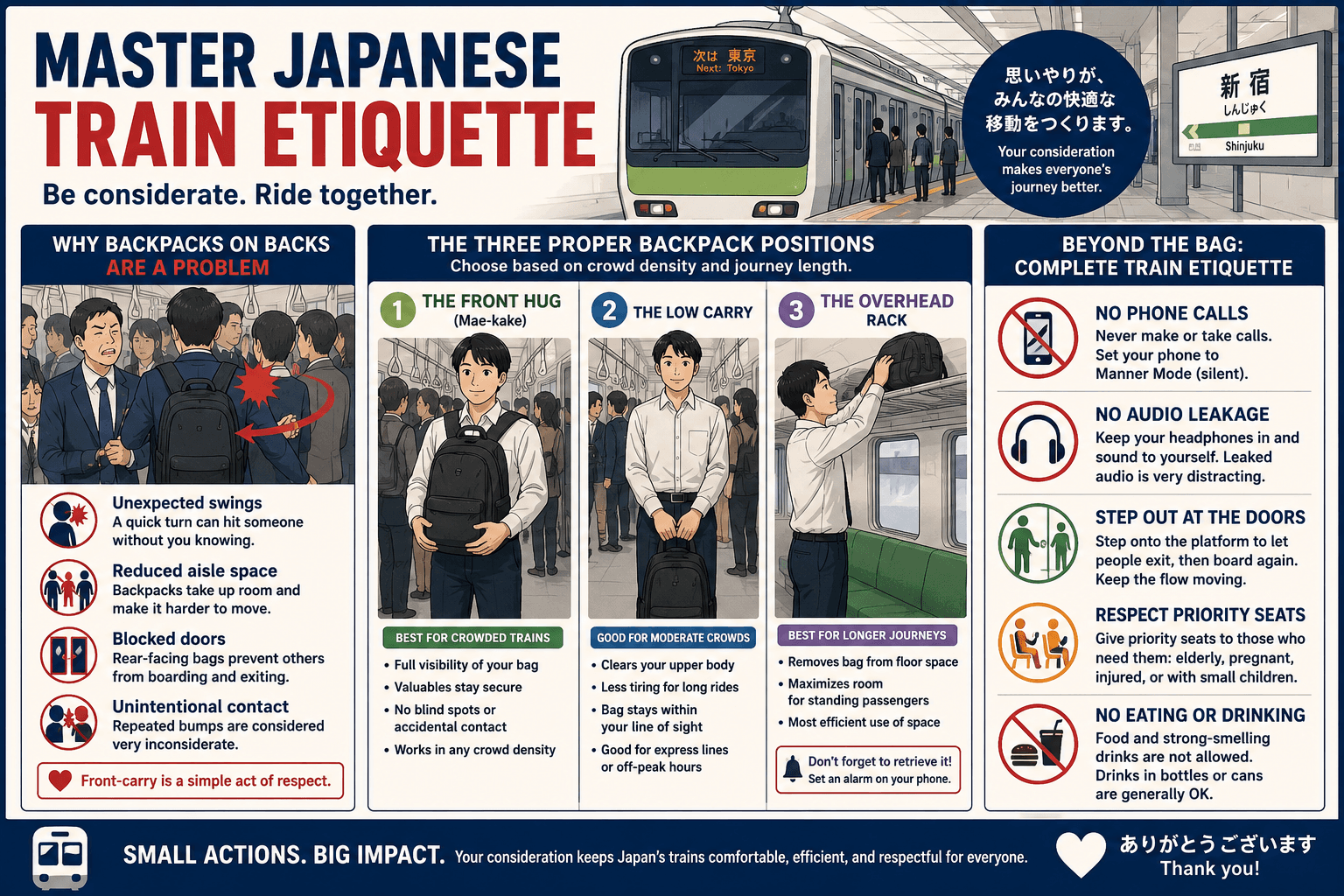
The rejection of traditional backpack-wearing isn't about fashion—it's pure physics. When a loaded backpack sits on your back during crowded conditions, you lose all awareness of its dimensions and movement. In a carriage packed shoulder-to-shoulder with strangers, this creates real problems:
Unexpected swings: A quick turn to check a station sign or glance at departing passengers can send your pack swinging directly into someone's face
Reduced aisle space: Backpacks extend your physical depth several inches backward, narrowing the central aisle and making it harder for people to board or exit
Blocked doors: Standing near exits with a rear-facing pack prevents others from moving freely during station stops
Unintentional contact: In Japan's culture of minimal physical intrusion in shared spaces, repeatedly bumping people with your bag is considered quite inconsiderate
In a society built on the principle of minimizing your personal impact on communal areas, switching your bag position is an active gesture of respect. It signals awareness and consideration—two highly valued traits in Japanese society.
The Three Proper Backpack Positions
Once you board, transition your bag into one of these three configurations immediately:
1. The Front Hug (Mae-kake)
This is the gold standard for crowded trains. Slide both shoulder straps off, rotate your pack to your front, and slip your arms back through the loops. Your bag now sits snugly against your torso where you can see and control it completely.
Advantages:
Full visibility of your bag's footprint and movement
Valuables stay secure and visible
No blind spots or accidental contact with others
Works in any crowd density
2. The Low Carry
If the train is moderately crowded rather than packed, simply hold your backpack by its top handle and let it hang down by your legs, roughly at knee or ankle level.
Advantages:
Clears your upper body, leaving overhead space for standing passengers to reach hanging straps
Less tiring than front-carrying for longer rides
Still keeps the bag within your line of sight
Good for express lines or off-peak hours
3. The Overhead Rack
On longer journeys, lift your bag onto the metal luggage racks mounted above the bench seats that run along the carriage walls.
Advantages:
Removes your bag from the floor space entirely
Maximizes room for standing passengers
Most efficient use of train space
Critical reminder: Don't forget to retrieve it before your station—marking your phone with an alarm is wise
Choose based on crowd density and journey length. During peak morning hours (7:30–9:00 AM) and evening hours (5:30–7:30 PM), expect maximum crowding; the front hug is your best bet.
Beyond the Bag: Complete Train Etiquette
Bag positioning is just one piece of the larger quiet-transit puzzle. Master these habits to become a considerate commuter:
Phone calls: Never make or take calls on a commuter train. It's one of the most universally hated behaviors. Keep your phone on "Manner Mode" (silent) the moment you enter the station.
Audio leakage: If you're listening to music or videos, ensure your headphones don't leak sound. In a silent carriage, tinny audio escaping from earbuds is remarkably distracting and marks you as inconsiderate.
The doorway step-out: When the train stops at a busy station and you're standing near the exit doors, don't try to hold your ground. Step completely out onto the platform to let people exit, then board again. This simple gesture prevents bottlenecks and shows spatial awareness.
Seat priority: Never sit in priority seats (usually marked with stickers or different colors) unless you're elderly, pregnant, injured, or traveling with small children. Even if empty, standing in front of them is the polite choice.
Eating and drinking: Food and strong-smelling beverages aren't permitted. Water and canned/bottled drinks are generally acceptable, but eating should wait until you reach your destination or a designated eating area.
Making It a Habit
Your first few train rides might feel awkward as you consciously adjust your bag position. But within a week, it becomes automatic—as natural as adjusting your stance on a moving vehicle. Japanese commuters have developed these practices because they work: they transform millions of daily journeys into peaceful, orderly experiences despite extraordinary crowding.
When you follow these norms, you're not just avoiding judgment—you're participating in something larger than yourself. You're respecting the shared responsibility that keeps one of the world's most efficient transit systems running smoothly.
Source: VOYAPON